The Great 2024 Total Solar Eclipse
10 April 2024
.jpg?updated=1712791212746)
This week was International Dark Sky week and there was also a Total Solar Eclipse in Mexico and North America. On Tuesday morning 9 April Facebook and social media was filled with amazing images of the spectacular event.
Solar eclipses occur when the sun, moon and Earth align. The moon passes between Earth and sun, temporarily blocking the sun’s light and casting a shadow on Earth. A total solar eclipse is when the moon fully obscures the sun, whereas a partial solar eclipse means it blocks just a portion of the sun’s face. Solar eclipses occur only with the new moon. Because the moon’s orbit around Earth is tilted, the three bodies don’t always line up in a way that creates an eclipse.
On 14 November 2014 we watched a partial solar eclipse on Norfolk Island. It was almost a total eclipse 98.30% obscured and the morning went very dark, the temperature dropped, and the birds acted strangely as the darkness fell across Kingston where we watched and photographed this amazing event.
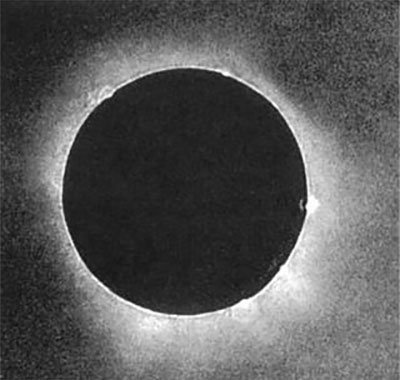
The first photograph of a Total Solar Eclipse was taken in 1851, 173 years ago. This was captured by Johann Julius Friedrich Berkowski on July 28, 1851. Berkowski, a skilled daguerreotypist from the Prussian city of Königsberg (now Kaliningrad, Russia), used the daguerreotype process to create this historic image.
.jpg?updated=1712791212746)
Astrophotography has come a long way over all those years, and we now marvel at the stunning images from NASA captured by the James Webb Space Telescope. This week I have found amazing amateur and professional images of this week’s 2024 Total Solar Eclipse. So many people now have cameras, using digital cameras, telescopes, traditional film cameras and mobile phones. Solar filters are required when watching and viewing the sun, as the bright light can damage your eyes and also damage camera and telescope lenses. I expect as this crossed American States and Mexico, this may be one of the most photographed total solar eclipses. Some areas were lucky and had clear skies and other found the sun was obscured by clouds. NASA live streamed the eclipse, and many people also videoed the event and shared on social media.
I have selected a few wonderful photos and shared on my Facebook page and collaged a couple for this week’s article. I found a great photo with a gentleman with multi cameras mounted to his Telescope, I hope he managed to capture the perfect shot.
This astrophotographer Nick Proudfoot describes planning where to be to capture his stunning photographs.
Nick Proudfoot Astrophotography
A truly speechless experience. Solar flares larger than the Earth spouted off the sun. After planning for the last 8 years for this, I settled in Ohio. The original plan was Niagara Falls, but 1 million people were expected there, and it was cloudy, rescheduled to Buffalo New York(clouds caused a cancellation there), then thought Canada (again-cloud blocked) and then considered Vermont and Maine. After a TON of researching different models, we found favorable conditions in Ohio along Columbia Station. You can plan all you want but have to be flexible at the last second and are at the mercy of nature. In the end, everything worked out perfectly. It was worth every second for that experience
For those asking, this was my set up. A motorized telescope mount, Nikon Z7 attached to a Nikkor 800mm 6.3 VR S lens. Thousand oaks handmade solar filter & remote intervalometer.
Eclipses in Norfolk Island (timeanddate.com)
Norfolk Island has a couple of Lunar eclipses on 14 March and 8 September 2025, but it will be many years before a Total Solar Eclipse will be seen here on Norfolk Island, this link suggest 2200. Check out this link for eclipses for Norfolk Island. We are small speck in the ocean, so the next solar eclipse is only partial, but can be viewed in areas on Australia and New Zealand in July 2028.
Solar Eclipses in History (timeanddate.com)
The word eclipse comes from ekleipsis, the ancient Greek word for being abandoned. The British astronomer and mathematician, Sir Arthur Eddington, used the total solar eclipse of May 29, 1919 to test Albert Einstein's theory of general relativity. By taking pictures of stars near the Sun during totality, Eddington was able to show that gravity can bend light. This phenomenon is called gravitational deflection.
This week the new moon also meant dark nights and if you were lucky enough to view the night skies this week, the stars would be stunning with no moon shine lighting up the night skies. Don’t forget to get out and enjoy our Norfolk Island Magical Dark Skies, we are so lucky to have limited light pollution on Norfolk Island and it needs protecting for our environment, birds and marine life and our future generations.
.jpg?updated=1712791212746)
.jpg?updated=1712791212746)
.jpg?updated=1712791212746)
Betty Matthews
12 April 2024