Royal Geographical Society of Queensland Geotrek to Norfolk Island 15 To 20 August 2024
12 September 2024
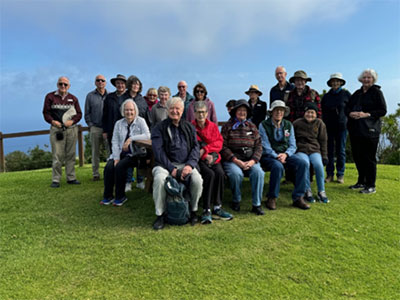
A group of twenty members of the Royal Geographical Society of Queensland visited Norfolk Island from 15 to 20 August. The objective of the trip was to gain a better understanding of the physical and human geography of the Island including its governance as an External Territory under Australian control.
The view from Mount Pitt gave us an appreciation of the landscape across the Island while the cutting behind Cascade Jetty showed us the variations in basaltic rocks probably coming from a volcano centered around Mount Pitt and Mount Bates. Roadside cuttings illustrated the depth of permeable red soils common in many parts.
Numerous people told us of the difficulties with water supply where homes, businesses and farms are reliant on rainwater and the limited supply of bore water, because of the absence of good dam sites. Since the 2019 – 2020 dry period when the Australian Defense Forces set up a desalination / purification plant to supplement supplies, people have endeavored to catch and store every drop that falls on their roofs.
We were lucky to visit Hadyn Evans farm and see the range of vegetables produced for the local market. Trickle irrigation with the tubes set up for re-use multiple times minimise water use from the farm bore. Hadyn told of the transport cost burden on inputs like fertilizers. He mentioned the vagaries of the local market where producers reliant on rainfall have to be opportunistic, leading to oversupply in good times.
Hadyn also mentioned grazing rights and the issue of animal quarantine prohibiting the occasional import of bulls to broaden the gene pool of Island cattle. Any new breeding material must come in as frozen bull semen or possibly embryos with associated storage, veterinary, and cattle handling costs.
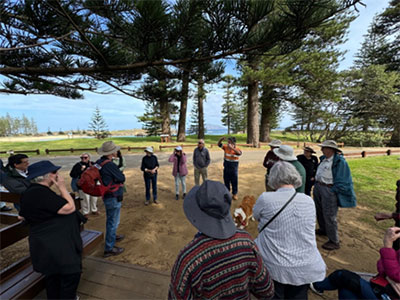
David Evans gave us a briefing on fishing and the way Norfolk Islanders conserve local fisheries with strategies like catch limits on some species during their breeding seasons. Nevertheless, illegal commercial fishing in the 188,000 square kilometer Norfolk Island Marine Park by overseas boats has damaged fish habitats and reduced stocks. Remoteness from the rest of Australia makes effective policing of fishing by outsiders very difficult.
In the National Park, Sara Freeland and Neil Tavener gave up their Sunday afternoon to show us some of the endemic species including, of course the Norfolk Island pine. They pointed out some of the invasive weed species like cherry guava and Hawaiian Holly (broad leaved pepper) and explained some of the vegetation rehabilitation work being undertaken. At the end of the afternoon, we appreciated their excellent commentary on a walk around the Palm Glen circuit.
Amanda at the Norfolk Island Wave Recycling Centre showed us the processes in place for managing domestic and commercial waste. This process starts with the residents sorting the waste followed by further sorting by Centre staff. This results in waste streams some of which go into compost, biochar, various sizes of glass sand for concrete, and coarser aggregate from recycled plastic, also for concrete. We found it very gratifying to see that so much waste has the potential to be reconstituted for reuse and we wonder why the processes are not scaled up for use in Australian cities. We observed crushed cars brought together, presumably for return to Australian facilities for recycling as transport opportunities arise.
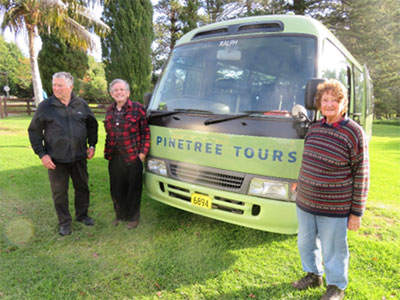
Many people helped us understand the human history and geography of the Island. Chris Lang raised the possibility of very early human habitation. Archaeologist Tom Sapienza showed us the Emily Bay Polynesian settlement site, explained what has been found there and suggested some reasons why the Polynesians may have vacated the Island. Neil Tavener showed us the site he identified where the Polynesians had worked stone tools, showed us some stone tools and explained some of the ways fine grained stone like basalt can be chipped and worked.
We heard many mentions of the first and second convict settlements but John Christian, who drove the Pinetree coach for us, was an amazing source of information. It is well known that Norfolk Island had a dark convict past, but we came to appreciate the absolute barbarity of conditions under some Commandants. The contrast of that barbarity, highlighted by inscriptions on some of the gravestones in the cemetery, with the grandeur of Government House and the surviving buildings along Quality Row is striking.
David Evans and John Christian gave us a lot of great background information on the Pitcairn Islanders, their language and culture and the move to Norfolk Island. The Cyclorama with its wonderful art and music took us right through their journey, starting with the Bounty.
At the RSL, Terence (Tet) Grube spoke to us of the long tradition of Norfolk Islanders serving in the Australian and New Zealand armed forces, particularly in times of war. As in Australia, war deaths on active service took a very heavy toll on the male line of many families. Tet also spoke of the construction of the WWII airfield and took us through the extensive and well curated Military Museum. Tet’s talk and the visit to the museum caused us to ponder on the current strategic position of Norfolk Island, particularly in the light of the apparent increase in China’s interest in the Pacific. Some of our group attended the Vietnam Veterans Day commemoration on Sunday 18 August as well.
Soon after our arrival, David Buffett and Chris Nobbs spoke to us at the Norfolk Island Knowledge and Learning Centre to give us some background on the past and present governance of the Island.
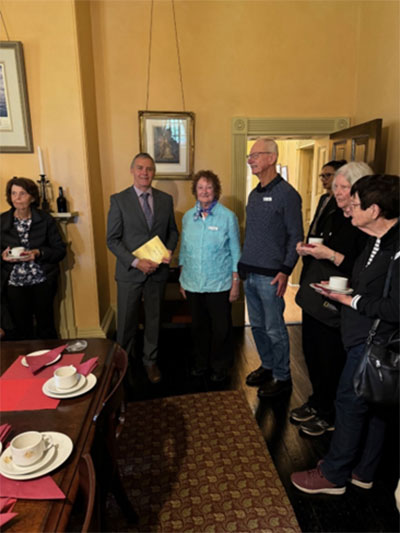
Our group was honoured to be invited to Government House for morning tea with Norfolk Island Administrator, George Plant. He
explained some of the background to the present governance of Norfolk and spoke of his roles as the Commonwealth Government’s representative on the Island and as a bridge between Islanders and the Government. As a token of our appreciation, Iraphne Childs, RGSQ past President, presented Mr. Plant with a copy of “A Dream in Trust”, a history of RGSQ 1885-1985.
We came to appreciate the difficulties of developing an appropriate governance model for an isolated island Territory where the residents as individuals, as families, and as a community, have a long tradition of self-reliance and independence. Difficulties are compounded because Commonwealth government officials endeavouring to negotiate a model are coming from a situation where the general Australain population has, over recent decades, become more accepting of government controls and more dependent on government support. Also, we became aware of the difficulties of funding the services that a local “Council” is expected to provide from the resources of a small community where freight costs are a major component of commodities brought from Australia or New Zealand.
On the final morning of our tour, we had a meeting with residents focused on the question “What is the carrying capacity of Norfolk Island?”. Our group shared some of our observations of the Island and heard residents’ concerns about the future of the Norfolk community. This brought out many aspects around sustainability such as demography, transport of goods to the Island, water and food supply, potential for food processing, pollution of the Slaughter Bay lagoon and associated reef, and waste disposal – all critical geographical issues.
Our geotrek would not have been nearly as successful without the assistance of Island resident Geoff Edwards. Some of us were acquainted with Geoff from his time in Brisbane so we approached him for assistance with organising the trip. Geoff arranged some events for us, including those at the Knowledge and Learning Centre; arranged for us to use that as a base; put us in touch with numerous knowledgeable people; and showed us his endeavours to manage his own land sustainably.