Life on the West Island - Gather round
13 April 2023
This week, Life on the West Island is in the Festival State, where Adelaide is in an AFL frenzy as Gather Round approaches. This fifth round of the AFL season is being entirely played in or just outside the capital of the Festival State, and it seems that all seats are sold and every accommodation bed fully booked, as thousands of footy fans flood in from distant parts of the West Island.
The round will commence on Thursday night with a clash at Adelaide Oval between early season improvers the Adelaide Crows and the Carlton Blues. Local media is flooded with player news and speculation about which glamour team will come out on top. (By the time you read this, the result will be known.)But although we will be going to the footy, the main purpose of our visit was to take part in several gatherings of a different type, related to family and community history.
On Easter Sunday, we took part in a reunion of one division of the family, descended from German religious refugees who settled in South Australia in the 1840s. In some ways, their story parallels that of the Pitcairners who came to Norfolk Island just a few years later. Both groups were taken from their families to distant and unfamiliar new locations, to open up and farm lands previously uncultivated, with little hope that they would ever return to the lands of their birth and facing years of hard labour. Our ancestors settled in the Barossa Valley, then cleared the land to plant food crops and fruit trees and especially to cultivate grapes to produce altar wines for religious ceremonies.
All of these ventures prospered but it was only in recent decades that wine grape-growing became predominant. After the government sponsored “vine pull” schemes of the 1980s, the Valley was dominated by stone fruit orchards and market gardens. During our school years, there were only a handful of large family-owned wineries such as Gramps, Seppelts, Penfolds and Yalumba, not to mention the largest of all – the Barossa Grapegrowers’ Cooperative, later to be christened Kaiser Stuhl (the King’s Seat) after the highest hill in the Barossa Range.
Now the Valley is awash with vineyards and all of those wineries have been bought out by multinational corporations and expanded into huge conglomerate winemakers, producing millions of litres of bottled wines for sale all over the West Island and in many export markets.
To complement these corporate behemoths, around 80 boutique wineries have sprung up around the Valley, often bearing the names of their celebrity winemakers, who are on hand at the cellar doors to autograph bottle labels and explain to visitors how the grapes were lovingly cultivated and hand-picked before being transformed into prestigious and often expensive premium wines through the skill and experience of the winemakers.
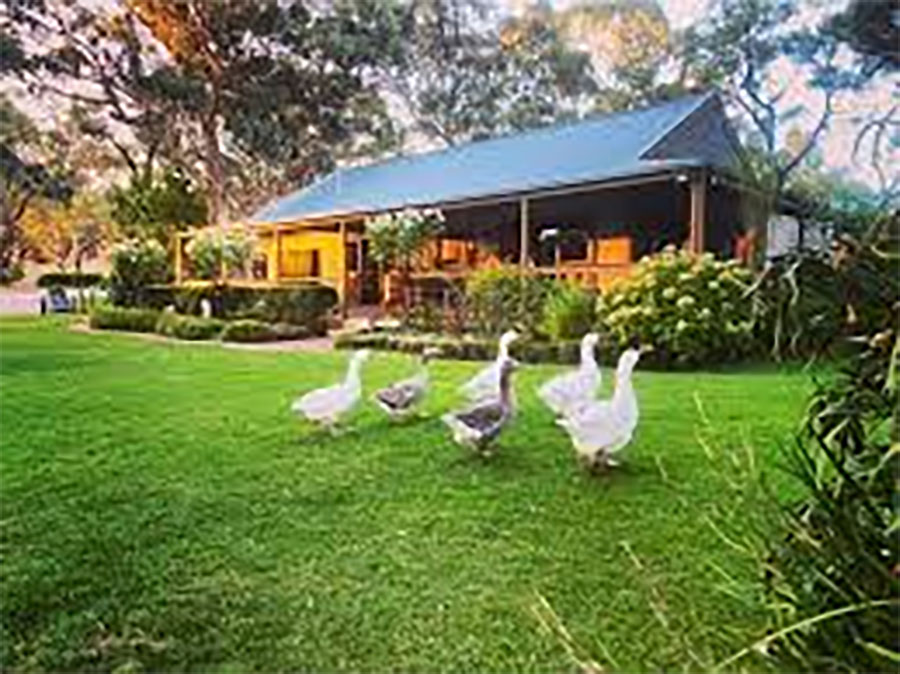
We stayed for five nights at a delightful Barossa bed and breakfast cottage operated at the site of a boutique winery by a third cousin, in the company of many domesticated pets including Buddy, an energetic young Border Collie, Rex the peacock, a gaggle of geese and a poultry shed containing numerous egg-laying hens. That is not to mention the seven “rescue roos,” raised by hand after being saved from the pouches of mother kangaroos killed on local roads. The cottage was immaculately maintained and supplied, surrounded by flowering gardens and sat atop a small hill overlooking Marananga – a small village with just a few houses and the tiny Gnadenfrei Lutheran church, but also boasting a band hall for its long-lived and very competitively successful brass band.
The Barossa is currently looking colourful as autumn progresses, with splashes of red, yellow and orange leaves and the scarlet of the glory vines which adorn many homes and trellises. The wine grape harvest is almost complete, and the famous Barossa Valley Vintage Festival is just around the corner.
Life on the West Island has previously reported on the remarkable Barossa story of the success of the Nuriootpa War Memorial Community Centre (NWMCC), operated and run by the people of this small town for many decades. It has provided and continues to operate a very wide range of community facilities and services such as a town hall, swimming pool, kindergarten, aged care home, numerous sporting facilities, parks, gardens, playgrounds and many more.
This has been made possible because the NWMCC owns and operates the Vine Inn community hotel and a range of retail outlets. Most prominent among the latter Is Barossa Fresh, one of the largest supermarkets in the country, which features much quality local produce and a vast array of cheeses, meats and yeast baked items. This means that you can buy all of your normal supermarket supplies and supplement them with some Barossa Washington or Maggie Beer cheese, a stick of mettwurst or fritz and some deutsche kuchen (German yeast or potato cake) or bienenstich (“beesting”).
West Islanders travel to Nuriootpa from the distant city and from a wide catchment area of regional centres to experience the joys of shopping at the wonderful supermarket, which also features a huge range of fresh fruit and vegetables and a dairy section as big as entire Woolworths or Coles supermarkets. Patrons can also park their shopping cart and enjoy a cuppa with some fresh German baked delights inside Barossa Fresh before resuming their grocery shopping.
Given its location in a sleepy small country town, its size, range and customer base is hard to comprehend. But if you are ever in the Barossa, gather round your family and friends and spend a few enjoyable hours savouring the sights, smells and tastes of Barossa Fresh!
We also took part in a series of community history and family gatherings, sharing anecdotes from our common histories and helping to collate family trees and details of family marriages and resulting descendants. All in all, it has been a week of successful and enjoyable gathering round.